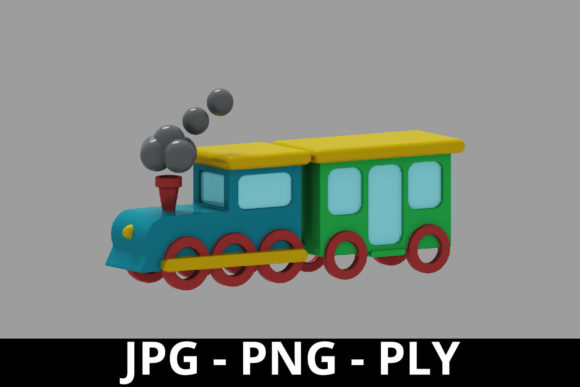
3d Rendering Train Toys for Design: A Comprehensive Guide to Digital Assets
The intersection of childhood nostalgia and modern digital craftsmanship has created a vibrant niche within the creative industry. At the heart of this convergence lies 3d rendering train toys for design, a specialized category of assets that bridges the gap between playful imagination and professional application. Whether you are a graphic designer crafting a children's book, an architect visualizing a miniature railway station, or a developer creating an educational app, these digital models offer unparalleled versatility.
This guide explores the multifaceted world of digital toy trains, examining how high-fidelity 3d illustration of locomotives, wagons, and accessories serves as a critical tool across various sectors. We will delve into the technical specifications, the diverse use cases, and the unique advantages of utilizing isolated, colorful, and detailed 3D assets in your workflow.
The Evolution of Digital Playthings
Gone are the days when designers had to rely on flat vector graphics or low-resolution photographs for projects involving transportation or childhood themes. The shift towards photorealistic 3d rendering has revolutionized how we depict objects like the classic steam engine or a modern electric loco. These assets are not merely images; they are complex digital sculptures comprising millions of polygons that capture every detail, from the texture of the metal wheels to the puff of smoke emanating from the chimney.
The availability of these assets in comprehensive ZIP folders containing JPG, PNG, and PLY formats ensures that creators have the flexibility to work with both raster and vector-compatible data. The inclusion of PLY (Polygon File Format) is particularly significant for researchers and engineers who need to analyze the geometry of the model without losing structural integrity. This level of detail transforms a simple concept of a toy train into a robust object suitable for rigorous design testing and visualization.
Key Characteristics of High-Quality Rendered Assets
When selecting 3d rendering train toys for design, professionals look for specific attributes that ensure the asset integrates seamlessly into their project. The quality of the render often dictates the success of the final output.
- Isolation and Background Removal: Most premium assets come isolated against transparent backgrounds. This allows designers to place a miniature train onto any backdrop, whether it is a bustling city street, a snowy landscape, or a clean white canvas for product photography.
- Lighting and Shadows: Advanced rendering techniques simulate real-world lighting conditions. The interplay of light on the colorful paint of a wagon or the metallic sheen of a locomotive adds depth and realism that flat illustrations cannot achieve.
- High-Resolution Textures: From the intricate rivets on a steam engine to the fabric patterns on passenger seats, high-resolution textures bring the model to life. Closeup views reveal details that were previously impossible to capture in digital media.
- Dynamic Elements: Some renders include elements like smoke or motion blur to convey speed. These dynamic aspects are crucial for marketing materials where conveying movement and excitement is essential.
Diverse Applications Across Industries
The utility of these digital assets extends far beyond simple decoration. Their ability to represent complex mechanical systems in a simplified, engaging manner makes them invaluable across multiple industries.
Educational Tools and Early Childhood Development
In the realm of education, 3d illustration of toddler-friendly objects plays a pivotal role. Educators and developers utilize these assets to create interactive learning modules. Imagine a virtual reality experience where a child can explore a railroad system, understanding how a passenger vehicle connects to an engine to form a complete transportation network. The vivid colors and recognizable shapes of a cartoon style train make abstract concepts of physics and engineering accessible to young minds.
Furthermore, these assets are perfect for creating flashcards and mobile applications designed to teach children about public transport and travel. The object is rendered with a friendly aesthetic, ensuring that the kid audience remains engaged while learning.
Marketing and Advertising Campaigns
For businesses, the gift market is a lucrative sector, especially during holidays. Marketers often require eye-catching visuals to promote toys, games, and seasonal products. Using 3d rendering train toys for design allows brands to create stunning advertisements without the logistical challenges of photographing physical props. A brand can showcase a wagon filled with gifts or a vehicle racing through a winter wonderland, all generated digitally.
The ability to customize the scene means that a company can tailor the design to match their specific branding guidelines. They can change the color of the train to match corporate colors or adjust the background to reflect a specific location, such as a station in London or New York, without moving a single physical camera.
Architecture and Urban Planning
While often associated with play, the principles behind miniature train sets are directly applicable to urban planning. Architects and city planners use scaled-down models to visualize infrastructure. A 3d rendering of a railway station, complete with platforms, tracks, and waiting passengers, helps stakeholders understand the flow of people and the spatial requirements of a new transit hub.
The precision of the machine components in these renders ensures that even small details, like the curvature of the rail or the spacing of the wheel axles, are accurate. This attention to detail is vital for creating realistic simulations of future public transport systems.
Technical Advantages of Multi-Format Availability
The decision to provide assets in a ZIP folder format containing multiple file types addresses the varied needs of different professionals. Understanding the strengths of each format is key to maximizing efficiency.
JPG files are ideal for quick previews and web usage. They are compressed, lightweight, and universally compatible, making them perfect for social media posts or blog headers featuring a toy train. PNG files, on the other hand, support transparency, which is essential for layering the render over different backgrounds in photo editing software like Photoshop or Illustrator. This is particularly useful when creating collages or composite images.
The inclusion of PLY files elevates the utility of the package for 3D modeling enthusiasts and technical users. PLY files preserve the mesh data, allowing the user to import the loco into software like Blender, Maya, or 3ds Max. Once imported, the model can be manipulated, rigged for animation, or broken down into individual parts. This capability opens up possibilities for creating custom animations, such as a passenger boarding a carriage or a steam engine pulling a long line of freight.
Considerations for Integration and Workflow
While the benefits are clear, integrating 3d rendering train toys for design into a project requires careful planning. Professionals must consider the scale and context of their work. A closeup shot of a colorful wheel might look great in isolation but could appear out of proportion if placed next to a full-sized building in a scene without proper scaling adjustments.
Lighting consistency is another critical factor. If the source image was rendered with a warm, sunset light, placing it into a scene lit by cool, midday sun will result in a jarring visual mismatch. Skilled designers often re-render the asset or apply post-processing filters to ensure the shadows and highlights align with the surrounding environment.
Additionally, copyright and licensing terms should always be reviewed. While many assets are available for commercial use, some may require attribution or restrict certain types of modifications. Ensuring that the 3d asset complies with the intended use case protects the creator and the business owner from potential legal issues.
The Future of Digital Toy Representation
As technology advances, the fidelity of 3d illustration continues to improve. Ray tracing and global illumination are becoming standard features, allowing for even more realistic reflections and refractions on the surfaces of toy vehicles. The integration of artificial intelligence is also beginning to influence how these models are generated, potentially allowing for rapid prototyping of unique train designs based on text prompts.
Moreover, the rise of augmented reality (AR) and virtual reality (VR) creates new opportunities for these assets. Users can now hold a digital train in their hands via a smartphone screen, seeing it move and interact with the real world. This immersive experience is transforming the way we consume content related to travel, transport, and play.
Conclusion
The 3d rendering train toys for design market represents a powerful resource for anyone looking to incorporate elements of transportation, childhood, and mechanics into their work. From the engine of a steam locomotive to the wagon carrying goods, these digital assets offer a blend of artistic expression and technical precision. By leveraging the variety of formats available, including JPG, PNG, and PLY, creators can unlock new levels of creativity and efficiency.
Whether you are designing a children's book, developing an educational game, or planning a large-scale infrastructure project, the right set of 3D assets can elevate your vision. As the digital landscape evolves, the humble toy train remains a timeless symbol of innovation, connectivity, and joy, perfectly captured in the medium of 3d rendering.