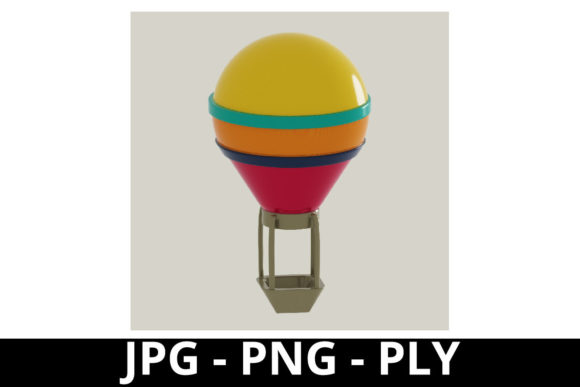
3d Rendering Air Balloon for Design: A Comprehensive Evaluation
In the evolving landscape of digital visualization, the 3d rendering air balloon has emerged as a versatile asset for designers, illustrators, and creative professionals. This specific collection is not merely a single image but a comprehensive package designed to facilitate high-quality projects ranging from travel brochures to romantic illustrations. By providing isolated assets that include JPG, PNG, and PLY formats, this resource offers flexibility that standard stock photography often lacks.
When evaluating design tools, it is crucial to understand the distinction between static imagery and 3D assets. The inclusion of PLY files indicates that the core model retains its three-dimensional structure, allowing for rotation and re-lighting, while the JPG and PNG renderings provide immediate use cases for flat layouts. This duality makes the 3d rendering air balloon a powerful tool for those seeking to balance efficiency with customization.
Understanding the Asset Composition
The core value of this design package lies in its technical diversity. A typical hot air ballon project requires specific visual cues to convey themes of adventure, romance, or transportation. The provided set includes a colorful and striped balloon, ensuring that the visual aesthetic matches various brand identities. Unlike a generic photograph, which captures a single moment in time with fixed lighting, these three-dimensional renders allow the user to control the environment.
The basket and the floating mechanism are rendered with attention to detail, capturing the physics of lift and float in a way that feels authentic yet stylized. The isolated nature of the background ensures that the subject can be seamlessly integrated into complex compositions without the need for tedious masking. Whether the goal is to depict a high altitude view or a close-up of the heat source, the render quality supports professional output.
Why Professionals Choose This Format
Designers often face the challenge of finding imagery that fits their specific composition needs. A 3d render of an air balloon solves several common problems associated with traditional stock photography.
- Customization of Lighting: Because the asset is a 3d model, you can adjust the light sources to match your scene's atmosphere, whether it is a warm sunrise or a cool twilight.
- Scale and Perspective: The ability to manipulate the camera angle allows for unique perspectives that are difficult to capture in real life. You can simulate the feeling of flying alongside the traveler or viewing the transport from a distance.
- Format Versatility: The ZIP folder structure containing PNG (for transparency) and PLY (for 3D editing) means the asset works across different software environments, from Photoshop to Blender.
- Thematic Consistency: For projects involving recreation or outdoor activities, the consistent style of the illustration ensures that all elements within a campaign look cohesive.
Evaluating Benefits and Tradeoffs
While the 3d rendering air balloon offers significant advantages, it is important to weigh these against potential limitations before committing to a workflow. The primary benefit is the recreation of a realistic object without the logistical costs of hiring a pilot or organizing a photoshoot. However, there are tradeoffs regarding the level of realism required.
Benefits:
The most notable advantage is the design freedom. You are not limited by the physical constraints of a real-world shoot. If a client wants the balloon to be purple instead of red, or if they need the sky to be a specific gradient, the render can be adjusted instantly. This is particularly useful for color-critical branding projects.
Tradeoffs:
The main consideration is the "uncanny valley" effect. While modern 3d technology produces stunning results, some viewers may detect the artificiality compared to a genuine photograph. Additionally, working with PLY files requires software capable of handling 3D geometry, which may require a steeper learning curve than simply dragging a JPG into a layout. There is also the factor of texture; while the striped pattern is clear, fine details like fabric wear might be less pronounced than in a high-resolution photo.
Situations Where This Asset is a Strong Fit
Certain scenarios make the 3d rendering air balloon an ideal choice. It is particularly effective in marketing materials where a clean, graphic look is preferred over gritty realism. For example, in travel agency websites promoting adventure tours, a stylized hotair balloon can serve as a friendly and inviting icon.
It is also excellent for romance themed content. The soft curves of the balloon and the association with sky travel evoke feelings of freedom and intimacy. In these contexts, the isolated nature of the render allows designers to place the subject against custom backgrounds that enhance the emotional tone without visual clutter.
Furthermore, for educational or informational graphics explaining the mechanics of heat and lift, the three-dimensional aspect is invaluable. The ability to show the internal structure or the relationship between the basket and the envelope helps clarify concepts that flat images cannot.
Alternatives and When to Look Elsewhere
Despite its utility, this asset is not a universal solution. If the project demands absolute photorealism, such as a documentary-style feature or a news report about a specific event, a real photograph would be more appropriate. Stock photography sites offer vast libraries of actual hot air ballon images that capture the unpredictable beauty of the natural world, including weather conditions and human interaction.
Additionally, if the project requires a highly specific location or cultural context that the generic 3d model does not provide, alternatives like custom photography or commissioned illustration might be necessary. For instance, if a client needs a balloon flying over a specific landmark that is not included in the standard library, a custom 3d build or a composite image using real photos would be the superior path.
Practical Decision-Making Insights
To determine if the 3d rendering air balloon aligns with your goals, consider the following checklist:
- Do you need flexibility? If you anticipate needing to change colors, angles, or lighting later, the PLY and PNG options in this ZIP folder are essential.
- Is the style graphic or photographic? If the design calls for a clean, illustrative look, the 3d render is likely a perfect fit. If realism is paramount, reconsider.
- What is your technical capability? Ensure your team has the software to open PLY files if you intend to utilize the full 3D capabilities of the asset.
- What is the theme? For topics like transportation, travel, and recreation, the thematic resonance of the hot air balloon is strong and generally well-received.
In conclusion, the 3d rendering air balloon serves as a robust tool for modern design projects. By offering a blend of high quality renders and editable 3D data, it empowers creators to produce compelling visuals that convey adventure and romance. While it is not a replacement for every type of imagery, its specific strengths in customization and versatility make it a valuable addition to any designer's toolkit.