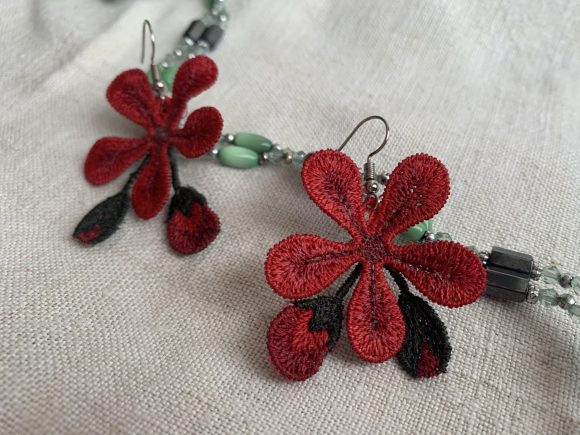
Geranium Earrings: A Practical Guide to Free-Standing Lace Embroidery
For crafters and small business owners looking to expand their product lines, the intersection of traditional embroidery techniques and modern jewelry design offers a unique opportunity. Geranium Earrings represent a specific niche within this market, combining the delicate aesthetic of free-standing lace with the recognizable beauty of Pelargonium flowers. Unlike standard fabric appliqué or printed designs, this project relies on the structural integrity of the thread itself to create a three-dimensional object that stands alone without a backing fabric.
The core concept is straightforward yet requires precision. The design features five similar petals characteristic of the Pelargonium geranium flower, arranged to mimic the natural symmetry found in nature. When executed correctly using high-quality stabilizers and appropriate machine settings, the result is a lightweight, durable accessory suitable for summer wear. This article evaluates the practical aspects of creating these earrings, from file compatibility to assembly techniques, providing an objective look at whether this design fits your workflow.
Understanding the Technical Requirements
The success of any free-standing lace (FSL) project hinges on the digital assets provided. The Geranium Earrings design is not merely a pattern; it is a complex vector structure that dictates stitch density and direction. One of the primary strengths of this resource is its versatility across different hardware ecosystems. It comes with multiple embroidery file formats, ensuring compatibility with a wide range of machines, from entry-level home models to industrial multi-head systems.
This flexibility is crucial for professionals who may need to switch between machines based on production capacity or available equipment. Whether you are running a boutique operation or managing a larger workshop, having access to various formats reduces the friction of setup time. However, users must verify that their specific machine software can interpret these files correctly. While the inclusion of multiple formats is a significant advantage, it does not guarantee universal plug-and-play functionality without proper digitization checks.
The design specifically targets the creation of 3D summer earrings. This implies a focus on breathability and lightness, which are essential for wearable accessories. The FSL technique achieves this by utilizing a grid of stitches that holds together through tension rather than fabric support. Understanding this distinction is vital for anyone attempting to replicate the design. If the stitch density is too low, the petals will lack definition; if too high, the piece becomes stiff and heavy, defeating the purpose of a summer accessory.
Assembly and Structural Integrity
Once the embroidery process is complete, the physical construction of the Geranium Earrings begins. The transition from a flat embroidered hoop to a wearable earring requires careful attention to detail. After removing the design from the stabilizer, you will need to stitch or glue all the elements together. This step determines the final shape and durability of the piece.
- Stitching: For a more organic look and added strength, hand-stitching the overlapping petals can provide better control over the drape of the flower. This method allows for subtle adjustments to the petal angles, ensuring the Geranium flower looks as natural as possible.
- Gluuing: Using a specialized textile adhesive is often faster and provides a clean finish for mass production. However, it requires precise application to avoid visible residue or stiffness in the center of the flower.
The choice between stitching and gluing depends largely on your production volume and desired aesthetic. For a single custom order, hand-finishing might be preferable. For a batch of products intended for sale, a reliable bonding agent may offer greater consistency and speed.
Performance in Real-World Applications
Evaluating the effectiveness of Geranium Earrings involves looking beyond the initial embroidery. How does the finished product hold up against daily wear? Free-standing lace is inherently durable because there is no fabric to tear or fray, but the thin threads used in the design can be susceptible to snagging if not handled carefully. The five-petal structure of the Pelargonium is robust enough to withstand normal movement, making it suitable for casual summer events, garden parties, or beach outings.
The lightweight nature of the design is its most significant asset. Heavy earrings can cause discomfort or damage earlobes over time, particularly when worn for extended periods. Because this design eliminates the need for a heavy backing material, the weight is distributed efficiently. This makes the earrings accessible to a broader audience, including those who prefer minimalist jewelry or have sensitive ears.
However, there are limitations to consider regarding longevity. While the embroidery itself is strong, the connection points where the earring hook attaches are potential weak spots. Over time, repeated insertion and removal of the hook could stress the thread. To mitigate this, it is recommended to reinforce the top of the flower with a small loop of sturdy thread before attaching the hardware. This simple addition significantly extends the lifespan of the product.
Who Benefits Most from This Design?
The Geranium Earrings project is tailored for a specific demographic of creators and entrepreneurs. Professionals in the fashion and accessory sectors will find value in the design's ability to produce a consistent, high-quality item that can be scaled. Small business owners can use this as a standalone product or as part of a seasonal collection, capitalizing on the popularity of floral motifs during warmer months.
Freelancers and bloggers focusing on DIY tutorials or crafting niches will also benefit. The project offers a compelling subject matter for content creation, demonstrating advanced skills like free-standing lace and 3D assembly. Educators teaching embroidery courses can utilize this design to introduce students to the complexities of FSL without the risk of fabric distortion.
Serious hobbyists seeking to elevate their craft will appreciate the technical challenge involved. Moving from standard surface embroidery to free-standing lace requires a deeper understanding of machine mechanics, stabilizer selection, and thread tension. Successfully completing the Geranium Earrings serves as a benchmark of proficiency in the field.
Practical Recommendations for Success
To ensure the best results, several factors must be managed carefully during the production process. First, select a stabilizer designed specifically for free-standing lace. Standard cut-away or tear-away stabilizers will likely fail to support the intricate geometry of the five-petal structure. A water-soluble topping or a heavy-duty stabilizer system is often necessary to maintain the shape during stitching.
Thread choice is equally critical. High-twist polyester or rayon threads are generally preferred for their sheen and tensile strength. Cotton threads, while natural, may lack the necessary rigidity to hold the 3D shape effectively. Additionally, testing the design on a scrap piece before committing to the final production run is a prudent step. This allows you to adjust tension settings and verify that the stitch count aligns with your machine's capabilities.
When attaching the earring hooks, ensure they are securely fastened. Use pliers to close the loops tightly, preventing them from opening accidentally. For a professional finish, consider adding a drop of clear nail polish or jewelry glue to the connection point to prevent loosening. These small details distinguish a handmade amateur piece from a commercially viable product.
Long-Term Value and Market Fit
In the context of the current market, Geranium Earrings offer a competitive edge due to their unique blend of artistry and utility. They appeal to consumers looking for personalized, artisanal items rather than mass-produced plastic jewelry. The floral theme resonates with seasonal trends, allowing creators to maximize sales during spring and summer months.
The availability of multiple file formats enhances the long-term value of the purchase. As technology evolves and new machines enter the market, having access to versatile file types ensures that the design remains usable for years. This future-proofing aspect is particularly important for entrepreneurs investing in digital assets for their businesses.
Ultimately, the decision to incorporate Geranium Earrings into your portfolio depends on your willingness to master the underlying techniques. The design is not a shortcut to quick profits; it requires skill, patience, and attention to detail. However, for those willing to invest the effort, the result is a distinctive product that commands respect in the crafting community and offers genuine value to customers seeking high-quality, handmade accessories.
By focusing on quality materials, precise assembly, and thoughtful presentation, creators can transform a simple digital file into a tangible piece of art. The Geranium Earrings project stands as a testament to the potential of machine embroidery when combined with creative vision and technical expertise.